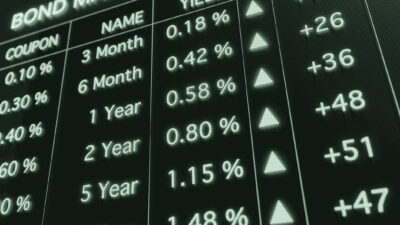
Bond investors are demanding higher yields, essentially raising the cost of borrowing no matter what the Fed decides to do in September.
Our daily email brings you smart and engaging news and analysis on the biggest stories in business and finance. For free.

The world’s largest sovereign wealth fund reported a record $184.3 billion profit in the first half of 2026 last week.
Wealth managers are looking beyond fixed income products into private markets and exchange-traded funds.
The yield on 30-year Treasury bonds hit the highest in 19 years after Warsh spoke following the Fed decision to hold interest rates.
Cat bonds pass insurance companies’ risk to investors.
Financial professionals are recommending staying in high quality products to help ride out any potential volatility.
Planners and investors are sticking to portfolio targets and rebalancing after years of strong stock market gains, according to Vanguard research.
The downturn comes at an interesting time: There are now 47% more sellers than buyers on the market, according to RedFin.
Yields on ultra-long 40-year Japanese Government Bonds (JGB) rose 0.26 percentage points Tuesday, reaching 4.2%, an all-time high.
European investors are the single-largest foreign holders of US treasuries and equities by far, holding $8 trillion in assets.
No reason to chase yield as advisors stick to quality fixed income.
In recent days the spread between the 10-year and two-year yields has been hovering near the highest levels since April.
It’s easy to recognize the folly of trying to predict the market, but there are still useful predictions to offer.
Portfolios with a mix of domestic and foreign stocks could be a more optimal way of diversifying than holding bonds, regardless of age, research suggests.
Is Wall Street’s golden ratio, the 60/40 division of portfolios between stocks and bonds, losing its luster?
Many advisors say the move isn’t enough to significantly change strategies.